вторник, 12 апреля 2016 г.


The Union Jack


The Union Jack, or Union Flag, is the national flag of the United Kingdom. The flag also has an official or semi-official status in some other Commonwealth realms; for example, it is, by law, an official flag in Canada and known there as the Royal Union Flag. Further, it is used as an official flag in some of the smaller British overseas territories. The Union Jack also appears in the canton (upper left-hand quarter) of the flags of several nations and territories that are former British possessions or dominions.
The claim that the term Union Jack properly refers only to naval usage has been disputed, following historical investigations by the Flag Institute in 2013.
The origins of the earlier flag of Great Britain date back to 1606.James VI of Scotland had inherited the English and Irish thrones in 1603 as James I, thereby uniting the crowns of England, Scotland, and Ireland in a personal union, although the three kingdoms remained separate states. On 12 April 1606, a new flag to represent this regal union between England and Scotland was specified in a royal decree, according to which the flag of England (a red cross on a white background, known as St George's Cross), and the flag of Scotland (a white saltire on a blue background, known as the Saltire or St Andrew's Cross), would be joined together, forming the flag of England and Scotland for maritime purposes. King James also began to refer to a "Kingdom of Great Britain", although the union remained a personal one.
The present design of the Union Flag dates from a Royal proclamation following the union of Great Britain and Ireland in 1801. The flag combines aspects of three older national flags: the red cross of St George of the Kingdom of England, the white saltire of St Andrew for Scotland (which two were united in the first Union Flag), and the red saltire of St Patrick to represent Ireland.
Notably, the home country of Wales is not represented separately in the Union Jack, being only indirectly represented through the flag of England representing the former Kingdom of England (which included Wales).
The terms Union Jack and Union Flag are both historically correct for describing the de facto national flag of the United Kingdom. Whether the term Union Jack applies only when used as a jack flag on a ship is a modern matter of debate.
According to the Parliament of the United Kingdom: "Until the early 17th century England and Scotland were two entirely independent kingdoms. This changed dramatically in 1603 on the death of Elizabeth I of England. Because the Queen died unmarried and childless, the English crown passed to the next available heir, her cousin James VI, King of Scotland. England and Scotland now shared the same monarch under what was known as a union of the crowns.
In 1606, James VI gave orders for a British flag to be created which bore the combined crosses of St. George and of St. Andrew. The result was the Union Jack, Jack being a shortening of Jacobus, the Latin version of James".
In 1908, a government minister stated, in response to a parliamentary question, that "the Union Jack should be regarded as the National flag".


вторник, 5 апреля 2016 г.

Joseph Lister, 1st Baron Lister
Joseph Lister, 1st Baron Lister, (5 April 1827 – 10 February 1912), known between 1883 and 1897 as Sir Joseph Lister, Bt., was a British surgeon and a pioneer of antiseptic surgery. By applying Louis Pasteur's advances in microbiology, he promoted the idea of sterile portable ports while working at the Glasgow Royal Infirmary. Lister successfully introduced carbolic acid (now known as phenol) to sterilise surgical instruments and to clean wounds, which led to a reduction in post-operative infections and made surgery safer for patients, distinguishing himself as the "father of modern surgery. "
Arthur Hailey


Arthur Hailey (5 April 1920 – 24 November 2004) was a British/Canadian novelist, whose works have sold more than 170 million copies in 40 languages. Most of the novels are set within one major industry, such as hotels, banks or airlines, and explore the particular human conflicts sparked-off by that environment. They are notable for their plain style, extreme realism, based on months of detailed research, and a sympathetic down-to-earth hero with whom the reader can easily identify.
Let's read and enjoy books  by Arthur Hailey 

пятница, 1 апреля 2016 г.

April Fools' Day (sometimes called All Fools' Day) is celebrated every year on 1 April by playing practical jokes  and spreading  hoaxes . The jokes and their victims are called April fools. People playing April Fool jokes expose their prank by shouting “ April Fool”. Some newspapers, magazines, and other published media report fake stories, which are usually explained the next day or below the news section in small letters. Although popular since the 19th century, the day is not a public holiday  in any country.
The custom of setting aside a day for the playing of harmless pranks upon one's neighbor is recognized everywhere. 
 In the UK, an April Fool joke is revealed by shouting "April fool!" at the recipient, who becomes the "April fool". A person playing a joke after midday is the "April fool" themselves.
In Scotland, April Fools' Day was traditionally called 'Huntigowk Day'. The traditional prank is to ask someone to deliver a sealed message that supposedly requests help of some sort. In fact, the message reads "Dinna laugh, dinna smile. Hunt the gowk another mile." The recipient, upon reading it, will explain he can only help if he first contacts another person, and sends the victim to this next person with an identical message, with the same result.
In England ‘fool’ is known by different names according to the part where it is celebrated. If you are fooled on this day you may be known as ‘noodle’, ‘gob’, ‘gobby’ or ‘noddy’.
In Ireland it was traditional to entrust the victim with an "important letter" to be given to a named person. That person would then ask the victim to take it to someone else, and so on. The letter when finally opened contained the words "send the fool further".
April Fool’s Day is here.
It is a day of fun.
If you are really clever.
You can fool someone!
Or someone may come
and tell a word to you.
And you may say
“Oh, no! Oh, no!”
But then they look at you
With a sly grin.
And that is when
Their fun begins!
“April’s fool!” they shout.
And then they laugh at you.
It is so much fun.
And you laugh too!


суббота, 26 марта 2016 г.

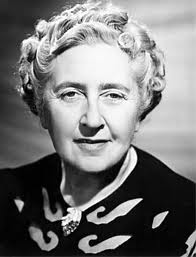
The first   Agatha Christie's novel "The Mysterious Affair at Styles"  was published on the 26 of March  1920.

AGATHA CHRISTIE
 Agatha Christie is known all over the world as the Queen of Crime. She wrote 78 crime novels, 19 plays and 6 romantic novels under the name of Mary Westmacott. Her books have been translated into 103 foreign languages. She is the third best-selling author in the world (after Shakespeare and the Bible). Many of her novels and short stories have been filmed. The Mousetrap, her most famous play, is now the longest-running play in history. Agatha Christie was born at Torquay, Devonshire. She was educated at home and took singing lessons in Paris. She began writing at the end of the First World War. Her first novel, The Mysterious Affair at Styles, was published in 1920.
That was the first appearance of Hercule Poirot, who became one of the most popular private detectives since Sherlock Holmes. This little Belgian with the egg-shaped head and the passion for order amazes everyone by his powerful intellect and his brilliant solutions to the most complicated crimes. Agatha Christie became generally recognised in 1926, after the publishing of her novel The Murder of Roger Ackroyd. It's still considered her masterpiece. When Agatha Cristie got tired of Hercule Poirot she invented Miss Marple, a deceptively mild old lady with her own method of investigation.

Her last Poirot book, Curtain, appeared shortly before her death, and her last Miss Marple story, Sleeping Murder, and her autobiography were published after her death. Agatha Christie's success with millions of readers lies in her ability to combine clever plots with excellent character drawing, and a keen sense of humour with great powers of observation. Her plots always mislead the reader and keep him in suspense. He cannot guess who the criminal is. Fortunately, evil is always conquered in her novels. Agatha Christie's language is simple and good and it's pleasant to read her books in the original.


понедельник, 21 марта 2016 г.


The International Day of Forests, the 21st day of March, was established by resolution of the United Nations General Assembly on November 28, 2012. Each year, various events celebrate and raise awareness of the importance of all types of forests, and trees outside forests, for the benefit of current and future generations. Countries are encouraged to undertake efforts to organize local, national, and international activities involving forests and trees, such as tree planting campaigns, on International Day of Forests. The Secretariat of the United Nations Forum on Forests, in collaboration with the Food and Agriculture Organization, facilitates the implementation of such events in collaboration with governments, the Collaborative Partnership on Forests, and international, regional and subregional organizations.International Day of Forests was observed for the first time on March 21, 2013. 
The rate of the deforestation in the world is alarming. Every day a hectare of the world's forests is being destroyed forever. Why is this happening? There are two reasons - land and wood. In many countries the trees have been cut down because the land was needed for crops. In other part of the world they cut down trees because their wood is wanted. This wood is used by the local people for firewood. Or it is exported to Japan, Europe and North America. There they used for buildings or for making furniture.
Unfortunately, in most places the trees won't be replaced. The soil in the forests is very thin, but it is protected by the trees. When trees are cut down, the soil is washed away by the rain or blown away by the wind. Soon nothing can be grown on it. The forest becomes a desert. Then people will need more land and they will cut down more trees.
When we destroy the forest, we lose not only the trees but the homes of millions of animals and plants together with them. At the moment there are between five and ten million species of animals and plants on the Earth. One million of these is extinct. All kinds of species are in danger - fish, reptiles, birds, insects - as well as thousands of plants.
Who is guilty of this disaster? The answer is simple: all of us. There are just too many people in the world. The world's population is now over one billion people. Of course, it's very easy to blame the local people. We don't chop down trees. They do. But the products are bought by people like you and me.The rate of the deforestation in the world is alarming. Every day a hectare of the world's forests is being destroyed forever. Why is this happening? There are two reasons - land and wood. In many countries the trees have been cut down because the land was needed for crops. In other part of the world they cut down trees because their wood is wanted. This wood is used by the local people for firewood. Or it is exported to Japan, Europe and North America. There they used for buildings or for making furniture.
Unfortunately, in most places the trees won't be replaced. The soil in the forests is very thin, but it is protected by the trees. When trees are cut down, the soil is washed away by the rain or blown away by the wind. Soon nothing can be grown on it. The forest becomes a desert. Then people will need more land and they will cut down more trees.
When we destroy the forest, we lose not only the trees but the homes of millions of animals and plants together with them. At the moment there are between five and ten million species of animals and plants on the Earth. One million of these is extinct. All kinds of species are in danger - fish, reptiles, birds, insects - as well as thousands of plants.

Who is guilty of this disaster? The answer is simple: all of us. There are just too many people in the world. The world's population is now over one billion people. Of course, it's very easy to blame the local people. We don't chop down trees. They do. But the products are bought by people like you and me.

четверг, 17 марта 2016 г.

The 17th of March - Saint Patrick's Day

Saint Patrick's Day or the Feast of Saint Patrick  is a cultural and religious celebration held on 17 March, the traditional death date of Saint Patrick (c. AD 385–461), the patron  saint of Ireland.
Saint Patrick's Day was made an official Christian feast day in the early 17th century and is observed by the Catholic Church, the Anglican Communion (especially the Church of Ireland), the Eastern Orthodox Church, and Lutheran Church. The day commemorates Saint Patrick and the arrival of Christianity in Ireland, and celebrates the heritage and culture of the Irish in general. Celebrations generally involve public parades and festivals, and the wearing of green attire or shamrocks. Christians also attend church services and the Lenten restrictions on eating and drinking alcohol are lifted for the day, which has encouraged and propagated the holiday's tradition of alcohol consumption.

Saint Patrick's Day is a public holiday in the Republic of Ireland, Northern Ireland, the Canadian province of Newfoundland and Labrador, and the British Overseas Territory of Montserrat. It is also widely celebrated by the Irish diaspora around the world, especially in Great Britain, Canada, the United States, Argentina, Australia, and New Zealand. Saint Patrick's Day is celebrated in more countries than any other national festival. Modern celebrations have been greatly influenced by those of the Irish diaspora, particularly those that developed in North America. In recent years, there has been criticism of Saint Patrick's Day celebrations for having become too commercialized and for fostering negative stereotypes of the Irish.